Earth-o1: A Purely Observations-driven Atmospheric World Model

完全基于观测驱动的通用大气世界模型

(† equal contribution)
(*; corresponding authors)
1 Shanghai Artificial Intelligence Laboratory, Shanghai, China  
2 Department of Information Engineering, The Chinese University of Hong Kong, Hong Kong, China
3 School of Electronic Information and Electrical Engineering, Shanghai Jiao Tong University, Shanghai, China  
4 Department of Atmospheric and Oceanic Sciences, Fudan University, Shanghai, China 
5 School of Information Science and Technology, University of Science and Technology of China, Anhui, China 
6 State Key Laboratory of Earth System Numerical Modeling and Application, Institute of Atmospheric Physics, Chinese Academy of Sciences, Beijing, China 
7 College of Computer Science and Artificial Intelligence, Fudan University, Shanghai, China  
8 Department of Earth and Environmental Engineering, Columbia University, New York, NY, USA  
9 Chinese Academy of Meteorological Sciences, Beijing, China  
10 School of Atmospheric Sciences, Nanjing University, Nanjing, China  

📰 News & Updates

  • 🚀

    December 5, 2025

    The Project Page are now live!

Abstract

The growing abundance of multi-source atmospheric observations provides unprecedented opportunities for real-time weather prediction and monitoring. Data assimilation (DA), the primary framework for integrating these diverse observations by incorporating them into the model space, currently exploits only a fraction of available observations. Similarly, forecast models initialized with DA initial fields are constrained by fixed grids, which further impairs the reconstruction and short-term prediction of local hazard. Here, we present a purely observation-driven atmospheric world model (Earth-o1), a next-generation, AI-based platform founded on a unified multimodal latent observation space that integrates diverse observational streams from satellites (both geostationary instruments and polar orbiters), and in-situ networks. Within this space, Earth-o1 learns the intrinsic dynamics of atmospheric evolution and supports flexible, arbitrary-resolution, multi-model, and multi-product forecasting and retrieval, enabling natural coupling across Earth subsystems. Earth-o1 delivers real-time atmospheric forecasts, high-resolution hazard monitoring, and cross-sensor retrieval products, while providing more diverse and timely diagnostic variables than ERA5 reanalysis and achieving forecast accuracy for surface in-situ observations comparable to IFS. This framework represents a step toward a living, closed-loop digital mirror of Earth, transforming heterogeneous observations into actionable intelligence for science and decision-making.

Overview of Earth-o1

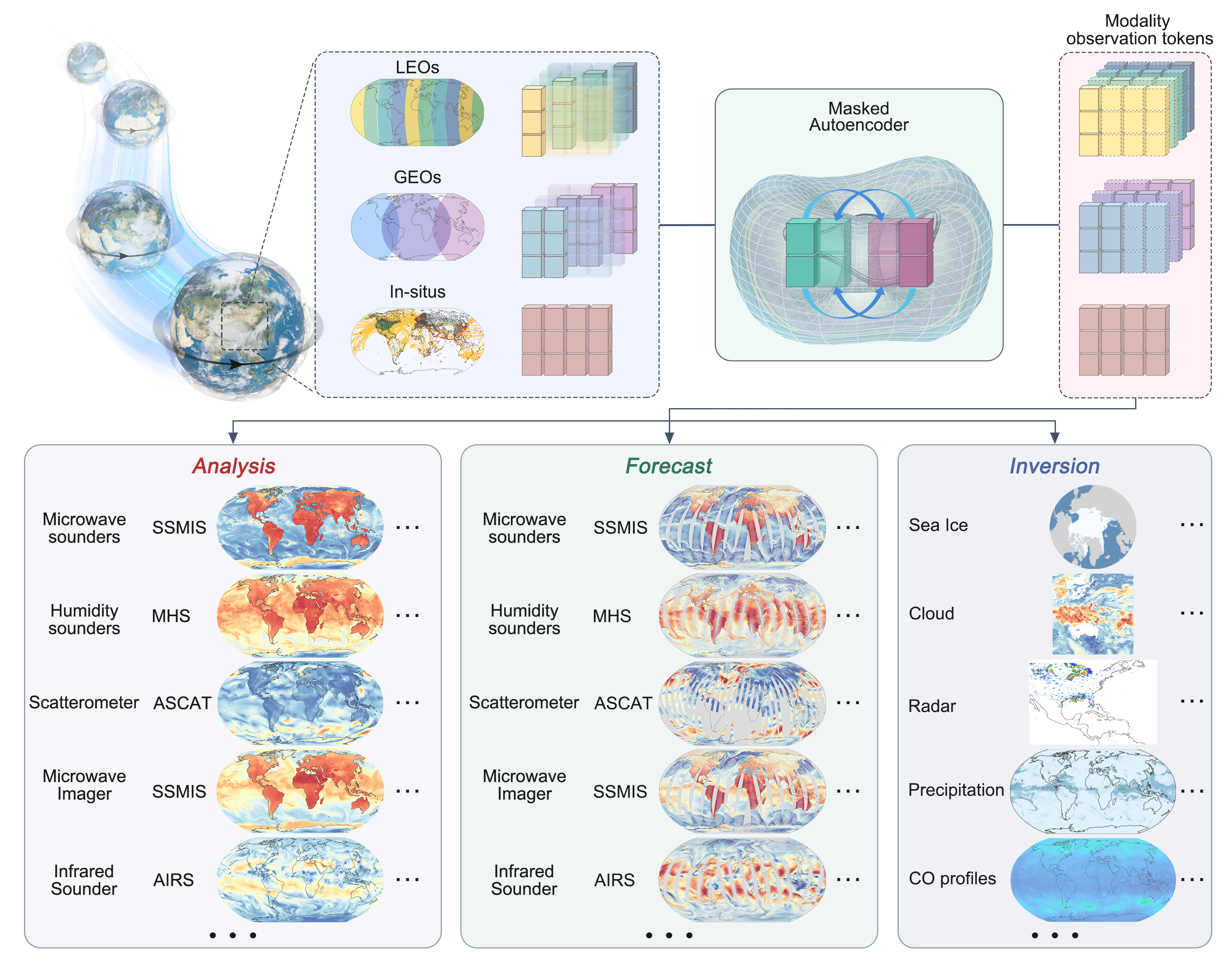
Teaser.

Overview of Earth-o1. After tokenization, multi-modal heterogeneous data from LEOs, GEOs and in-situ platforms are trained via a Masked Autoencoder, where representations are mutually integrated to generate modality observation tokens. Analysis: these latent observation tokens support multi-sensor analysis tasks including microwave and infrared remote sensing. Forecast: facilitate the forecasting of observation signals. Inversion: enable the inversion of downstream geophysical products; as illustrated in the figure, high-value products such as sea ice concentration and CO concentration are inverted.